Intro
I’m so excited to bring you another segment of “Through the Lens,” a series of detailed visual analysis’ of video games! On this episode, we’ll be breaking down the visuals in Horizon Zero Dawn. Based on my experiences with the game, I can say it’s holistically, easily one of my favorite games of all time. My experience from start to finish with Horizon Zero Dawn was nothing short of amazing, and I’m itching to jump back in and start again on hard mode. I’ll refrain for the time being, considering there are a number of other titles for me to explore.
Still, Horizon Zero Dawn’s exploration, combat, music, sound design, and visuals absolutely just blew me away, and I’m so excited to do a deep dive into this game. We’ll be discussing these visual elements and analyzing just how Guerrilla Games transformed themselves to create this visual spectacle, which was quite a bit of a departure from their previous games.
Intention & Art Direction
It’s clear at first glance that Horizon Zero Dawn’s concept is a culmination of melding old and new- Both from an overall design theme, to it’s narrative philosophy. The entire package pays homage to both nature and manmade constructs by combining tribal, primitive structures and “old” remnants of the days before with large futuristic structures.
Looking at the combination of the game’s environment and character/creature design, it’s clear to me they’ve succeeded in conveying a sense of primitivity, despite the fact that robotic “animals” roam the world and the people of this world are literally surrounded by technology. It’s convenient then, that the game also explains why this is, as you uncover secrets about what went down (don’t worry no spoilers.) Trying to blend so many elements, including cultural references, could have easily became disjointed, but they took care to be very mindful of that.
Character Designs
As previously mentioned, Horizon Zero Dawn adopts a design philosophy that combines concepts from new, highly technological influences, to old, more primitive design languages. The most immediate examples of this are the armors, weapons, and enemies you face off against.
Aloy’s first bow, the Carja Bow, combines natural and synthetic elements to create a beautiful hybrid that essentially encapsulates the aforementioned design philosophy. It brings these worlds together and explains how people living on earth essentially treat the machines as animals by combining wood as the base, parts from fallen mechs as the arms, and bird feathers.
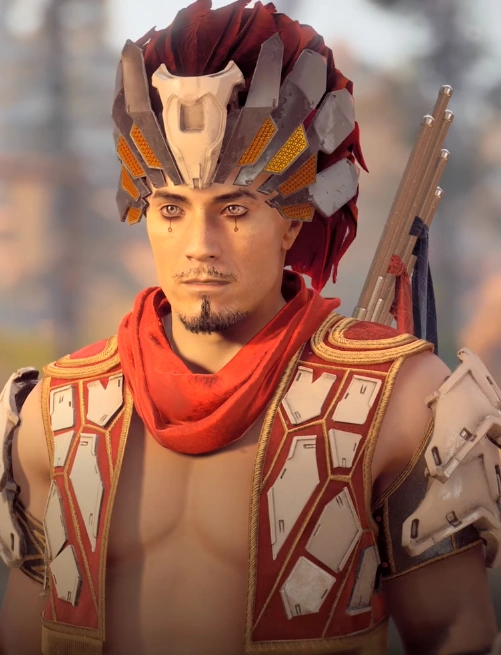
Speaking in terms of the amor characters adorn, many characters in the game wear elaborate decorative armor that once again, pulls in elements of traditional and high tech elements with cloth, leather, and fallen machine parts. Nil for example adorns a headdress-like armor piece on his head, complete with feathers on the back of the helmet, with metal shoulder plates, a cloth vest with metal neatly lined on the material, and metal gauntlets, and similarly protected waist and leg guards. His aesthetic also follows somewhat of a samurai, phoenix like appearance, that gives the character a sort of lone ronin, fire headed aesthetic.
Other characters, like Uthid adorns thick leather armor and metal plating wrapping around his frame with emblems and sigils representing his elite general status amongst the Shadow Carja. His aesthetic more closely blends a sort of traditional samurai/romanesque aesthetic, taking elements from the helmet towards the back and sides of the front.
My favorite armor however is the Carja Blazon Heavy armor. I was surprised that there were so many samurai-styled designs in this game, considering the default Nora armor, and the best armor in the game- the Shield Weaver armor, have strong ties to Native American designs. The Carja Blazon Armor really catches my attention because of the striking resemblance to both a modern Samurai take, and a Phoenix. I love the beautiful mixture between heavily decorational patterned cloth, leather, and armor wrapped around her frame and complimenting the natural shapes on Aloy so well. I love the scarf, rope belt, and cloth/sash on her right side, and the phoenix head headdress, paired with interesting placement of armor and exposed skin, with her elbows, hands, and belly still visible. It may not be the most protective, but visually, the contrast creates an effect I can appreciate. This speaks directly to my aesthetic, as I tend to prefer slimness that allows for flexibility and freedom of movement while also having a sense of elegance through drapery that ebbs and flows with the wind. You’ll notice in some of my very own designs I adopt those same principles.
Additionally, and of course one of the most standout aspects of this game, has been the existence of mechanized creatures, and their role in the story. We won’t go into details as to why there are mechanized creatures, but I can at the very least say that the visuals alone create surreal imagery, especially when you consider how life like these robotic creatures are. They move, and often times function just like their organic counterparts, complete with their own method of biomass consumption. Seeing each individual metal part on a towering Thunder Jaw, with it’s interlocking neck and multi-segmented tail is breathtaking, especially when you combine that with a lush and sprawling landscape that these mechanized beasts contrast with so elegantly.
Environments
Environments are a beautiful hybrid between remnants of times long gone, and lush, sprawling plant life, filled with organic and synthetic mechanized creatures. Additionally, there are settlements created by earth’s remaining inhabitants, ranging from small, tribal-like towns and villages of the Nora, to larger, elaborate structures of the Carja, with highly detailed spiraling staircases, and elevator systems.
In terms of the natural environments, we get a really awesome mixture of different environments, rendered in beautiful, impressive, and staggering detail. Stealthily sneaking in a snowy field, just trying to make it past a group of Glinthawks, only to climb a tall cliff to find a ravenous Stormbird awaiting you, with swirling winds mixed with sleet makes you FEEL the cold in a way that makes that moment special. Witnessing the sunlight peek through a massive hole in a desolate mountainside environment not only tells a tragic story, but creates such incredibly beautiful imagery that just sticks with you. And conversely, following a river towards a waterfall, with fish, geese, and rabbits lining the river gives this odd sense of “peace,” despite the fact that danger looms just around the corner. In these peaceful environmental set pieces, wildlife still has gone on without humans, seemingly unaffected by the events that brought the world to it’s initial end.
Quickly speaking on some of the villages, structures, houses, and furniture all remind me of traditional Native American aesthetics, fulfilling the role of telling the story of how the generations after us resorted to using more traditional methods of accomplishing their goals compared to the generations before them (us.) I love the lodge style feel to the buildings, and the ominous interior of the Nora temple, that holds the deep secrets about humanity’s fall.
Tech
Horizon Zero Dawn utilizes what’s known as the Decima Engine, developed in house by Guerrilla Games which was initially used for Killzone Shadowfall, but then used for Until Dawn, and RIGS, and modified for Horizon Zero Dawn. Although Guerrilla Games initially had some issues getting the engine to fit their needs, including issues with draw distances and loading, ultimately the engine ended up working really well for Horizon Zero Dawn. Conversely, I wonder if similar effects could have been achieved if Guerrilla Games simply used another engine, like the Unreal Engine instead, which has been one of the industry standards for game development for some time, and utilized in a huge number of titles. I did a little more digging to see what the advantages of building an engine like this had for Guerrilla Games.
According to an interview with develop-online and Jan-Bart Van Beek, studio Art Director at Guerrilla Games, “A mixture of procedural and hand crafted design allows the team to create authentic biome-style areas, complete with systems, by utilising what Guerrilla calls World Data. ‘Decima has allowed us to elegantly construct various natural settings via the development of World Data,’ says van Beek. ‘This is a standardized stack of data and rulesets that are customizable for the various natural settings (or ecotopes) throughout the game world.’”
They employed a massive number of artists to help realize this world due to the complexity of the individual elements in this game. There were roughly 10 different roles specifically for character artists, ranging from concept artists, facial animators, technical animators, texture artists, and more. Including the environmental and robotic artists, there were likely around 200 internal and external artists working together on Horizon Zero Dawn, which is staggering yet believable considering the visual complexity HZD embraced.
Incidentally enough, the man who inspired me to be an artist, Hideo Kojima is also working in conjunction with Guerrilla Games on utilizing the Decima Engine for his own upcoming project Death Stranding, which I’m incredibly excited to learn more about.
Custom Tailored
If I had to have it be just perfect for me, there are a few things I’d change from a visual standpoint. Many of these elements admittedly, cater to a very specific aesthetic I enjoy more-so than anything, but some of these ideas I feel may fundamentally enhance the experience.
Firstly, I’d love to see Aloy wield a katana to go alongside Aloy’s more samurai-like armors. It’s very clear that the armors and costumes in HZD adopt aesthetics from several cultures, and the Native American vibe of the Nora Brave armor completely compliments her bow and staff. Taking it a step farther with different melee weapons, specifically a katana, complete with new animations, could add some much needed depth to the melee combat.
The second element I would change would be the Shield Weaver Armor. The thing is, I’ve got no issues with how it is now. Functionally, it’s incredibly useful, and visually it looks amazing, playing with the old & new dichotomy. However, I’d love to see an option to fuse that with other armors, like my personal fav, the Carja Blazon armor.
Lastly, I’d push true 4k and 60fps, if I’m getting ambitious here. Honestly, I’m incredibly satisfied with this game’s visual performance, both technically, and stylistically, so this is just icing on the cake.
Conclusion
Horizon Zero Dawn is a absolute visual, masterpiece. Since we’re specifically analyzing the visuals here, I’ll stick to praising its visual depth and immense attention to detail. There are very few games that have matched the beauty in this game, and for that reason, I consider it a golden standard in visuals.